INSIGHTS2 September 2026
From Viral Moment to Volunteer Roster
A viral doorknocking video becomes rostered pre-poll shifts within a week. Cheap automation closes the gap between attention and capacity.
For most of the last decade, a viral moment was treated as its own reward. The clip travelled, the follower count jumped, the group chat glowed, and a fortnight later nothing about the campaign had materially changed. The distance between online attention and offline capacity was measured in weeks of manual work — spreadsheets, copied-and-pasted emails, a volunteer coordinator triaging an inbox at midnight — and attention decays much faster than manual work proceeds.
That distance has now collapsed, and it collapsed quietly. The change is not a single product but a threshold: the point at which a two-person digital team can wire a full supporter journey together over a weekend.
A weekend in an inner-city campaign
Picture a community-independent campaign in an inner-city electorate — the kind run out of a borrowed shopfront with more corflutes than chairs. A volunteer films one of the campaign's oldest doorknockers, a retired schoolteacher in her eighties, making her pitch on a rainy Tuesday with a disarming lack of polish. The clip is watched a few hundred thousand times in two days. In the old story, that is where it ends: a warm feeling, a follower spike, a slow return to baseline.
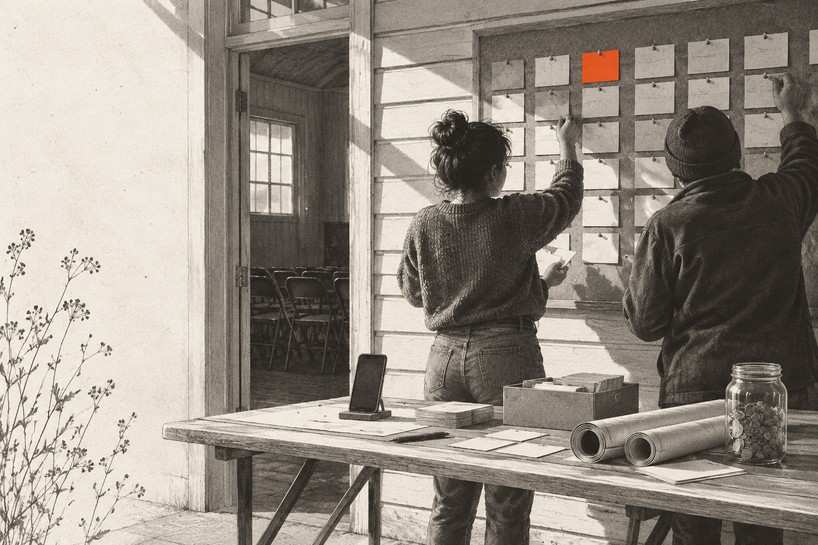
Instead, the campaign's two digital staff spend the Saturday wiring. A sign-up form goes into the video's caption and every reply. An open-source automation platform connects the form to the supporter database and the messaging tool. A conversational assistant helps draft the follow-up sequence — a welcome message in the campaign's actual voice, a suburb-matched invitation, and a pre-poll roster with real shifts at real booths. Every message is read and edited by a human before the sequence switches on. By the end of the following week, a little over nine hundred sign-ups have become a few hundred replies, roughly sixty rostered pre-poll shifts, and four new doorknockers — one of whom heard about the campaign from the video of the first.
What actually closed the gap
It is tempting to credit the assistant, but the assistant's contribution was modest: drafting variants, matching register, proposing the shape of the sequence. The structural change is the wiring. Automation platforms — the visual, no-code kind and the open-source, self-hostable kind — have made the connective tissue between tools nearly free. Work that once meant a contractor, a quote and a six-week wait is now a weekend for anyone comfortable reading a settings page.
Which means the real asset is no longer the tooling but the readiness. Viral moments cannot be scheduled. The campaigns that convert them are the ones whose pipes were laid before the rain — form, database, sequences, roster — sitting tested and idle, waiting for weather.
The part that does not automate
A viral form collects everything: supporters, sceptics, journalists, bored teenagers, people three states away, duplicates, and at least one obvious fake name. Pipe that straight into your database and you have automated the creation of a mess you will be cleaning for months. Data hygiene is the unglamorous half of the weekend — dedupe against the existing list, gate the merge behind a human check, let postcode decide what people are actually asked to do. The interstate admirer gets invited to make persuasion calls, not to a booth she cannot reach.
Consent is the other half. The form said plainly what would follow — messages about volunteering for this campaign, nothing else — and every message carried an opt-out that actually worked. It is worth being honest that the Privacy Act's political exemptions mean much of this is ethics rather than compliance for a campaign. That is a reason to hold the standard, not to relax it: the supporter who feels processed unsubscribes from the movement, not just from the list.
Attention as a supply line
Under compulsory preferential voting, the prize was never getting these nine hundred people to vote; they were always going to vote. The prize is what they do for the campaign — the shifts at pre-poll, the how-to-vote cards handed over with a sentence of conviction, the conversations in the queue that shift how a neighbour numbers the boxes. Attention, properly plumbed, becomes a supply line for exactly the labour that persuasion still requires.
That is the honest shape of the change. The viral moment was never the victory. It is now, for the first time, reliably the raw material of one — provided somebody spent a weekend on the wiring, and provided the wiring respects the people flowing through it.
SEE WHAT PROGRESS CAN DO IN YOUR CAMPAIGN
Book a demo and we'll show Progress working inside one of your own campaigns.